Business Operations
7 Signs Your Team Needs Operational Support
Seven clear signs your team needs operational support — overloaded founders, poor onboarding, repeated errors, silos, and stalled growth.
Business Operations
Seven clear signs your team needs operational support — overloaded founders, poor onboarding, repeated errors, silos, and stalled growth.
If your team is struggling with inefficiencies, missed deadlines, and constant firefighting, it might be time to rethink your operations. Here are seven clear signs that your team could benefit from external support:
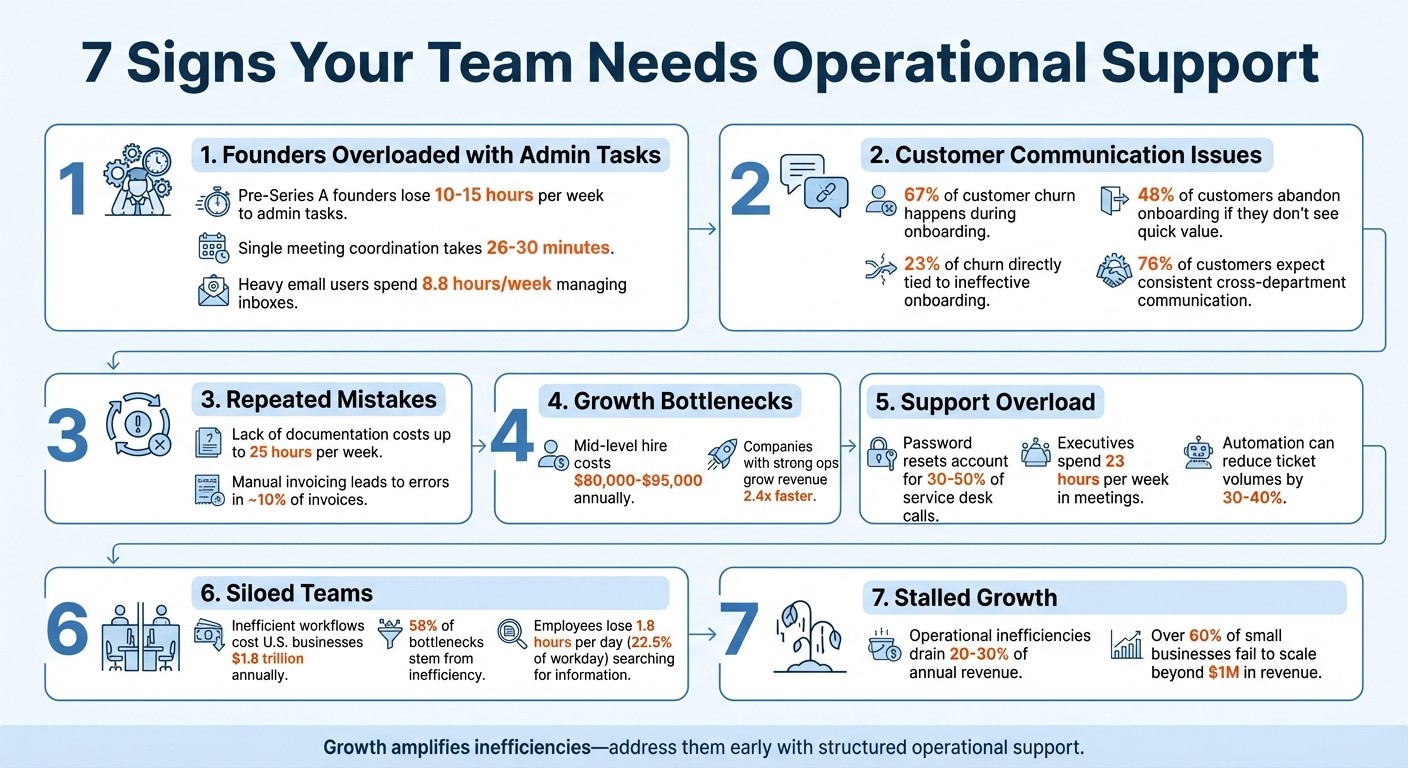
Founders Overloaded with Admin Tasks: Founders spending 10–15 hours a week on emails, scheduling, and CRM updates instead of focusing on growth.
Customer Communication Issues: Poor onboarding and siloed communication lead to churn, with 67% of customers leaving during onboarding.
Repeated Mistakes: Lack of documented processes causes errors and wastes up to 25 hours weekly.
Growth Bottlenecks: Scaling without fixing core systems leads to delays and inefficiencies.
Support Overload: High ticket volumes and downtime show gaps in infrastructure and tools.
Siloed Teams: Poor coordination and scattered information create bottlenecks and frustration.
Stalled Growth: Operational gaps drain 20–30% of revenue and prevent scaling.
Key Takeaway: Growth amplifies inefficiencies. Addressing these issues early with structured support and clear processes can save time, reduce costs, and improve team performance. Managed support services, like those offered by HeyBuddy Solutions, provide affordable, scalable solutions to these challenges.
If you're spending hours scheduling meetings across time zones, dealing with an overflowing inbox, reconciling receipts, or manually updating your CRM, you're not driving your business forward - you’re holding it back. These time-consuming tasks can bog down decision-making and add to the operational hurdles startups already face.
On average, pre-Series A founders lose 10–15 hours each week to administrative tasks. That’s nearly two full workdays gone. Just coordinating a single meeting can take 26 to 30 minutes when you factor in back-and-forth emails and time zone juggling. Add to that the 8.8 hours a week heavy email users spend managing their inboxes, and the time drain becomes glaring.
"Your attention is the scarcest resource your company has; where you point it directly contributes to your company's efficiency." – Matthew Collins, Prialto
The real loss here isn’t just time - it’s the missed chance to focus on high-impact activities. If your time is worth $500 to $1,000+ per hour for crucial tasks like closing deals or securing funding, even a quick 30-minute task like sending a calendar invite becomes a costly distraction.
CEOs already work an average of 62.5 hours per week, yet 36% of that time is consumed by reactive tasks instead of strategic planning. This creates a bottleneck: when you’re the one approving every minor detail or handling admin work, your team’s progress slows down. Decisions get delayed, and team members spend valuable time waiting on your input.
It’s no surprise that 53% of startup founders reported experiencing burnout in 2024, with nearly half saying it directly affected their ability to lead effectively.
The solution? Apply the "Repeatable, Reactive, Low-Leverage" framework. Delegate tasks that are predictable, interrupt-driven, and don’t require your expertise - things like scheduling, managing your inbox, reconciling expenses, and updating your CRM.
But don’t just offload individual tasks - delegate entire processes. Start by documenting these workflows with Standard Operating Procedures (SOPs). Clearly define what "done" looks like and set quality benchmarks to minimize follow-ups and micromanagement.
Managed operational support services can make this process even easier. Unlike freelancers, who require training and oversight, managed services come with built-in support. These providers often include an engagement manager to handle training, quality control, and process documentation. This frees you to focus on what truly matters - growing your business.
For instance, HeyBuddy Solutions' Shared Capacity plan offers 80 hours of structured support per month for $899. Services include inbox management, scheduling, CRM updates, and escalation handling, giving you back those 10 to 15 hours a week for strategic work.
Up next, let’s explore how communication challenges with customers can also highlight the need for operational support.
When customers have to repeat details they’ve already shared during sales calls or onboarding drags on for weeks without progress, it’s clear there’s a communication breakdown. These aren’t just minor inconveniences - they’re signs your processes might be falling short, risking customer satisfaction and retention.
Here’s a concerning statistic: 67% of customer churn happens during the onboarding phase, with 23% of churn directly tied to ineffective onboarding processes. Even worse, nearly half of customers (48%) will abandon onboarding altogether if they don’t quickly see value. If your team is still relying on spreadsheets or email threads to track customer progress, critical details can easily fall through the cracks.
Sometimes the biggest problems are the easiest to overlook. For example, 76% of customers expect consistent communication across all departments. But when your Sales, Customer Success, and Finance teams operate in silos or use disconnected tools, customers can get conflicting updates. One system might show a customer as “live,” while another indicates they’re still waiting on integration.
"The most expensive churn in B2B SaaS does not happen at renewal - it starts on day one." – Jay Levy, Onboard
Jay Levy’s concept of “silent churn” is a real threat - this happens when customers stop engaging instead of voicing their frustrations. If you notice a drop in login frequency by week three or see onboarding tasks stalled for over two weeks, you could be losing that customer without even realizing it. A common weak spot is the handoff from sales to service, where key details like promised outcomes, integration needs, and pain points often get lost.
Customer Success Managers relying on manual tools like spreadsheets spend up to 30% to 40% of their time on administrative tasks rather than focusing on actual customer support. Without a unified system to manage the customer lifecycle, your team can end up scrambling to find critical information instead of delivering a seamless experience.
The first step? Fix the handoff. Use required CRM fields to capture implementation-critical data before closing a deal and create a formal internal handoff checklist. This ensures customers don’t have to repeat themselves and reduces the risk of losing important context.
Then, standardize your processes. Build automated workflows into your playbooks to trigger reminders when customers stall. Structured onboarding pays off - customers who complete it have a 21% higher lifetime value than those who don’t. Plus, 86% of customers are more likely to stay loyal when you provide educational onboarding content.
If your team struggles to keep up with daily customer communication, consider managed operational support. For example, HeyBuddy Solutions’ Full Capacity Support plan offers 160 hours per month for $1,600. This includes inbox management, CRM updates, escalation handling, and process documentation. With a dedicated team lead and account manager, you’ll get consistent support - even during internal staff absences - and weekly updates to monitor customer health.
The benefits can’t be ignored. Boosting customer retention by just 5% can increase profits by 25% to 95%. And since acquiring a new B2B SaaS customer costs 5 to 25 times more than keeping an existing one, improving customer operations is a smart move for long-term growth. These communication gaps might seem small, but they’re often the first sign of deeper operational issues that could impact your entire business.
Up next: how repeated process errors could be holding your team back.
When founders are stretched thin and customer communication breaks down, repeated errors - like invoicing mistakes or misplaced customer details - often point to process gaps rather than individual shortcomings. Relying on someone’s memory to manage critical tasks creates a fragile system that can grind to a halt if that person becomes unavailable.
A lack of clear documentation can drain a company’s resources, costing up to 25 hours per week in repeated explanations and avoidable mistakes. For example, manual invoicing leads to errors in roughly 10% of invoices, potentially causing lost revenue and damaging client relationships.
Simpo CEO Yuval Karmi shared a real-world example in January 2026: the company lost a $30,000 client because an undocumented escalation process was overlooked by a new account manager. Once they implemented structured documentation for customer success processes, they cut new hire ramp-up time from six weeks to just two. The impact of undocumented workflows extends beyond inefficiency - it translates into lost revenue and the erosion of valuable institutional knowledge.
"You cannot scale what you cannot systemise." – Farah Cohen, The Ops Engine
The consequences of routine mistakes can be costly. Highly paid employees, like a $150,000-per-year salesperson, shouldn’t spend their time hunting for information that should already be accessible in a shared system. This inefficiency highlights the pressing need for clear, standardized documentation.
To address these issues, focus on documenting processes with the "High Frequency/High Pain" principle. This means prioritizing workflows that are both frequent and critical, such as customer onboarding, revenue-generating tasks, and security protocols. Documentation doesn’t have to be overly complex - consider using "Just-in-Time" methods, like recording a screen share while completing a task, to quickly and accurately capture the process without drafting long manuals.
"If documentation is everyone's responsibility, it's no one's responsibility." – Yuval Karmi
Assigning specific team members to maintain and update documentation ensures consistency and accountability.
For teams struggling with repeated mistakes and limited bandwidth for internal documentation, HeyBuddy Solutions offers a Full Capacity Support plan. For $1,600 per month, you get 160 hours of operational support, including process documentation, CRM updates, and escalation management. A dedicated team lead and weekly summaries help standardize your systems, freeing your internal team to focus on growth.
The benefits are tangible: reducing new hire ramp-up time from six weeks to two weeks can make a huge difference when scaling rapidly. Efficiency like this can be the deciding factor between achieving growth milestones or falling into a cycle of constant problem-solving.
Next, we’ll dive into why growth bottlenecks can persist even without adding more team members.
When your revenue starts climbing but your team size remains the same, the strain becomes hard to ignore. Many businesses encounter operational challenges as they grow from $1 million to $10 million in revenue. At this stage, any weaknesses in your systems become glaringly obvious. If every major decision still flows through the founder, it’s a clear sign that your operational structure is stretched to its breaking point. These bottlenecks reveal deeper systemic issues that only get worse as you scale.
Hiring more people might feel like the natural solution when growth slows, but it often backfires if your systems are flawed. As SimpleScale aptly puts it:
"People amplify systems. They don't repair them. If the system is messy, more people make it messier - and more expensive."
Consider this: a mid-level hire typically comes with an annual cost of $80,000 to $95,000. If your workflows rely on undocumented, informal knowledge, new hires can spend months just trying to figure out how things work instead of contributing meaningfully.
The root issue isn’t a lack of manpower - it’s poor system design. When consistent results depend on heroic efforts, like late nights or extraordinary individual contributions, your operations are fundamentally broken. On top of that, executives today spend an average of 23 hours per week in meetings - a dramatic increase from previous decades. This rising coordination burden eats into the productivity gains you expect from scaling.
To escape this cycle, you need support that grows with your business without requiring constant headcount expansion. By focusing on well-documented processes and streamlined delegation, flexible managed support can help you scale efficiently. Companies with strong operational management grow revenue 2.4 times faster than their competitors. Startups with structured operational support are also 40% more likely to survive beyond 24 months. Instead of hiring a $95,000 employee who may take months to fully ramp up, managed support offers immediate, measurable results.
For example, HeyBuddy Solutions' Full Capacity Support plan provides 160 hours of operational support per month for just $1,600 per seat. This package delivers the equivalent of a full-time operations associate without the hassle of recruiting, onboarding, or managing a new hire. With services like daily availability, process documentation, CRM updates, and escalation management overseen by a dedicated team lead, you can boost output without adding headcount. This allows founders to focus on strategic growth instead of getting bogged down in day-to-day operations.
The key is to build a solid operational foundation before your systems fail. Waiting until everything breaks usually results in expensive, disruptive fixes. As your team grows - typically from 10 to 30 employees - the difference between smooth scaling and constant chaos comes down to whether you’ve documented your processes or left critical knowledge scattered in people’s heads.
An overflowing support queue and frequent system outages are clear signs that something deeper is wrong. When ticket volumes rise, it often means your infrastructure isn’t keeping up with your growth. For instance, systems designed to manage 500 endpoints won’t function effectively when stretched to 1,500. Add to that manual workflows and disconnected tools, and you get "operational drag" - simple tasks taking far too long because your systems don’t talk to each other.
Sometimes, the biggest warning signs are the ones you overlook. Take password resets, for example. If they make up 30–50% of all service desk calls, that’s a lot of time wasted on something that could easily be automated. Tickets sitting in a queue for 5 to 30 minutes just waiting for manual categorization? That’s another delay. And if over 30% of support tickets could be resolved with a knowledge base but aren’t, inefficiency is costing you more than you think.
Recurring issues are another red flag. If you’re seeing multiple tickets for the same problem, it’s likely you’re treating symptoms instead of fixing root causes. High turnover in your support team - anything above 25% - can lead to what’s called a "Talent Death Spiral." This is when institutional knowledge fades away, making every issue harder to solve. Without centralized documentation, troubleshooting becomes inconsistent, and outages take longer to resolve, especially when key team members are unavailable. These patterns make one thing clear: reactive fixes aren’t enough. You need preventive strategies.
Automation and proactive monitoring are game-changers. Automating processes can lower ticket volumes by 30–40%. Self-healing scripts are particularly effective - they can fix common issues like clearing disk space or restarting services before users even notice a problem. Automated ticket categorization and routing, paired with continuous monitoring, help resolve issues before they spiral out of control.
Managed services combined with advanced monitoring tools can also make a huge difference. For example, HeyBuddy Solutions offers a Full Capacity Support plan that includes constant availability, detailed process documentation, and escalation management. For $1,600 per seat, you get 160 hours of operational support every month, overseen by a dedicated team lead. This approach allows you to systematically monitor, document, and solve problems rather than constantly putting out fires.
Shifting from disconnected tools and spreadsheets to a unified platform creates a "single source of truth". When your entire team can easily see system health in real time, you minimize the risks tied to tribal knowledge. As Laura Clayton from UptimeRobot explains:
"Good observability feels boring. When incidents happen, teams know where to look. They spend less time debating data and more time fixing problems."
When teams operate in silos, communication gaps are inevitable: Sales might promise something Operations can't deliver, and Marketing may act independently without input from other teams. This often leads to questions like, "Who owns this?" or "Who can approve this?" - clear signs of undefined accountability. These disconnects create inefficiencies that sap both productivity and revenue.
In fact, inefficient workflows cost U.S. businesses over $1.8 trillion annually. A staggering 58% of bottlenecks stem from inefficiency, and 64% of employees report frustration with siloed processes.
The signs of misalignment are easy to spot once you're aware of them. Disconnected systems force employees to waste time searching for information. Projects stall during handovers when dependencies aren't documented clearly, and "shadow systems" like personal spreadsheets or private email threads often emerge as workarounds for broken processes.
"If your team's best workaround is a spreadsheet, you've got a workflow problem".
This quote from Morgan, a process improvement consultant, underscores the issue. When critical knowledge is stored only in individuals' heads, the departure of a single employee can result in a significant loss of institutional knowledge. On average, employees lose 1.8 hours per day - about 22.5% of their workday - searching for information or coordinating between tools.
Breaking down silos and improving team coordination doesn’t require a complete overhaul. Start with tools like RACI matrices (Responsible, Accountable, Consulted, Informed) to clarify roles and responsibilities across departments. Regular cross-department check-ins and assigning a single point of contact can also help reduce miscommunication.
Another key step is creating a single source of truth by consolidating data into one unified dashboard. This eliminates the "information scavenger hunts" that drain productivity. For example, HeyBuddy Solutions’ Full Capacity Support plan offers a structured approach. For $1,600 per seat, it provides 160 hours of monthly operational support, complete with dedicated team leads and account managers to ensure smooth coordination and accountability.
Taking these steps to improve coordination not only addresses inefficiencies but also sets the stage for tackling larger operational challenges ahead.
When growth starts to plateau, it's tempting to point fingers at market conditions or increased competition. But more often than not, the real culprit lies within: unresolved operational issues that have quietly piled up over time. These inefficiencies can drain 20% to 30% of annual revenue. Shockingly, over 60% of small businesses fail to scale beyond $1 million in revenue because they lack the systems needed to break through these barriers. These problems, if ignored, compound over time, demanding immediate attention and restructuring.
The warning signs are hard to miss. If hiring more team members only leads to more chaos instead of streamlining workflows, something is fundamentally flawed. When tasks that should take hours drag on for days due to clunky manual processes, operational friction is holding you back. And when leadership meetings spiral into arguments over conflicting data instead of driving decisions, you're facing a serious strategic disconnect.
Growth bottlenecks tend to follow familiar patterns. One common issue is centralized decision-making, where a founder becomes the bottleneck. If every pricing tweak, hiring decision, or internal conflict needs their input, the company’s ability to scale is severely limited. Another major roadblock comes from outdated, manual processes. Relying on spreadsheets, disconnected tools, and redundant data entry creates unnecessary friction, slowing progress and frustrating teams.
There's also the problem of "heroic efforts." If your engineer is pulling all-nighters to patch recurring issues or the founder spends a week every month reconciling payroll, the business is leaning on individuals instead of fixing systemic problems. These short-term fixes might work for a small team, but as the company grows past 10–15 people, they become unsustainable and lead to burnout.
"If adding people doesn't reduce chaos - if headcount grows but coordination only gets harder - you don't have a capacity problem. You have a design problem." - SimpleScale
Another hidden blocker is the lack of documented processes. When critical knowledge is stored in employees' heads instead of accessible systems, every departure weakens the company. This forces new hires to start from scratch, stalling progress and creating inefficiencies.
Addressing these operational challenges is crucial to overcoming growth stalls. The first step is to identify the root causes rather than just treating surface-level symptoms. A simple yet effective approach is to ask your team, "What’s one task you do each week that feels harder than it should be?" Their answers can uncover the biggest sources of friction.
Next, move away from founder-centered decision-making by clearly defining which decisions require leadership input and which can be delegated to teams. This redistribution of decision-making authority not only speeds up processes but also empowers employees. Additionally, document essential workflows and procedures in the form of checklists or standard operating procedures (SOPs). Transitioning from a memory-based system to a process-driven one creates a scalable framework for growth.
For immediate improvements, consider managed operational support. For example, HeyBuddy Solutions offers a Full Capacity Support plan that provides 160 hours of operational assistance per month for $1,600 per seat. This includes dedicated team leads and account managers who handle tasks like customer communication, process documentation, and daily coordination - without the expense of building an internal team.
The takeaway is clear: growth doesn't fix problems; it magnifies them. Operational issues that seem manageable at $1 million in revenue can become deal-breaking threats at $5 million. Tackling these challenges early isn’t just about fixing inefficiencies - it’s about laying the groundwork for sustainable scaling. By addressing these issues head-on, you set the stage for smoother operations and long-term growth.
If any of these seven signs sound familiar, rest assured - you’re not alone. It’s common for startups with 10 to 30 employees to reach a point where professional operations become essential. The scrappiness that fueled your early wins can’t sustain long-term growth. In fact, growth doesn’t solve operational challenges - it amplifies them.
The seven signs we’ve discussed highlight the importance of addressing operational gaps. But don’t worry - this doesn’t mean you need a massive overhaul or a hiring spree. Transitioning from "scrappy" to "scalable" involves creating dependable systems that replace one-off heroics. It’s about reclaiming the 70% of a CEO’s time currently spent on tasks that distract from strategic priorities. By building an operational foundation, your team can focus on driving revenue instead of constantly putting out fires.
"Operational excellence is not the opposite of startup culture. It is what enables startup culture to continue working as companies grow." - Escalon
Managed operational support provides a practical solution. It eliminates the costs and complexities of recruiting, onboarding, and managing new internal hires. Companies like HeyBuddy Solutions offer structured support with built-in oversight, so you don’t need to add extra layers of management. For instance, their Full Capacity Support plan provides 160 hours of operational assistance per month at $1,600 per seat. This includes dedicated team leads who oversee customer communication, process documentation, and daily coordination.
The real question isn’t whether you need operational support - it’s whether you’ll address these issues now or wait until they become roadblocks to growth. Systems need to be in place before they become critical, because you can’t scale what isn’t systemized. By acting now, you set the stage for sustainable growth and empower your team to focus on what they do best.
Delegating tasks such as workflow management, customer support, inventory management, bookkeeping, and data entry can make a big difference in how efficiently your business operates. These tasks tend to consume a lot of time and, if not managed well, can slow down overall progress. By assigning these responsibilities to others, your team can shift their energy toward driving growth and handling strategic priorities. This approach not only lightens the workload but also ensures smoother day-to-day operations and better scalability.
If your workflows feel disorganized, overly manual, or disconnected - like tools that don't sync properly or constant questions from new hires - it might be time to focus on better process documentation. Clear documentation can help streamline operations and make scaling much smoother.
On the other hand, if your team is constantly running into bottlenecks, making mistakes, or dealing with role confusion - things like late payments or missed customer requests - it could be a sign that you need to hire more staff. While documentation tackles inefficiencies, increasing headcount can help handle immediate workload demands while you refine your processes.
To gauge how effective operational support is, keep an eye on key metrics like cycle time, time to resolution, first-contact resolution rate, automation rate, error rates, and resource utilization. These metrics provide insight into efficiency, highlight bottlenecks, and track progress in refining processes and workflows.
Our platform is designed to empower businesses of all sizes to work smarter and achieve their goals with confidence.
May 18, 2026
Best Freelance Sites for Businesses in 2026 and Why Some Teams Outgrow Them
Apr 22, 2026
Best Project Coordination Tools for B2B Teams in 2026
Apr 17, 2026
In-House vs Managed Operations: What Growing Teams Need
Mar 5, 2026
Outsourcing Customer Support for Startups