Business Operations
In-House vs Managed Operations: What Growing Teams Need
Business Operations
When your business grows, deciding between building an in-house team or outsourcing operations is key. Here’s what you need to know:
In-House Operations: You hire, train, and manage employees directly. This gives you full control, aligns teams with your goals, and builds long-term expertise. However, it comes with high fixed costs (like salaries and benefits) and slower scalability.
Managed Operations: Outsourcing tasks to third-party providers offers flexibility, faster scaling, and lower costs. You pay only for what you use, but you’ll have less direct oversight and customization.
Cost: In-house is more expensive upfront; managed services turn fixed costs into variable ones.
Control: In-house offers full control; managed services focus on outcomes via contracts.
Scalability: Managed services scale faster; in-house requires longer hiring and training processes.
Expertise: Managed providers bring specialized skills; in-house relies on internal capabilities.
Support: Managed services often provide 24/7 coverage; in-house may require extra hires for extended hours.
Key takeaway: If you prioritize control and long-term team alignment, in-house may be the way to go. If flexibility, cost savings, and quick scalability matter more, managed operations could be the better choice. A hybrid model can balance the best of both worlds.
In-house operations involve handling tasks internally with your own employees - individuals you hire, train, and manage directly. These team members are not external contractors or partners; they are full-time employees who integrate into your company’s culture, work within your systems, and report to your leadership team.
This setup provides direct control over tasks like CRM management and customer support. Your team is responsible for daily operations, such as entering data, managing workflows, responding to customer tickets, and ensuring collaboration across departments. They also take care of administrative duties like license renewals, vendor coordination, system updates, and maintaining documentation. The feedback process is quick since everyone operates within the same (physical or virtual) workspace. For instance, customer complaints can be relayed to the product team in minutes rather than days. This structure offers a clear picture of the benefits and challenges tied to managing operations internally.
Creating an in-house operations team means defining roles with specific responsibilities. These can include:
Coordinators: Focused on daily tasks like CRM data entry and generating reports.
Analysts: Build dashboards, analyze metrics, and provide actionable recommendations.
Managers and Directors: Oversee workflow design, set strategic goals, and align operations with revenue objectives.
Most companies begin hiring dedicated operations staff once they reach 15 to 25 sales reps or spend more than $50,000 annually on marketing technology. A common staffing ratio is one operations team member for every 15 to 30 sales reps, depending on the complexity of the business.
Infrastructure costs are another factor to consider. CRM licenses, helpdesk software, and hardware can range from $3,000 to $8,000 per agent. Recruitment and onboarding take time too - typically 8 to 14 weeks. These clearly defined roles and investments help ensure the agility and control that make in-house operations effective.
The primary advantage of in-house operations is control. You set the hiring criteria, select the tools, design workflows, and build the culture. According to Deloitte, 80% of businesses say in-house teams provide better control over projects. Your employees develop a deep understanding of your brand and product, creating valuable institutional knowledge over time.
Cultural alignment is another key benefit. Companies with strong internal cultures report 72% higher employee satisfaction, which directly influences performance. When your team understands and believes in your mission, they represent your brand more effectively. Additionally, retaining employees saves money - up to $15,000 per employee in rehiring and retraining costs. For industries like healthcare or finance, keeping compliance-heavy work in-house isn’t just a preference - it’s often a necessity.
Despite the benefits, in-house operations come with significant fixed costs. In the U.S., a customer service agent earns $35,000 to $45,000 annually in salary alone. Once you add benefits, payroll taxes, office space, and equipment, the hourly cost ranges from $25 to $45. For software developers, annual salaries can exceed $120,000. These costs remain constant, even during slower business periods, making them a long-term commitment.
Scaling an in-house team is another challenge. Growth is gradual and requires time. You can’t instantly double capacity during a demand surge. Hiring new staff takes months, and there’s always the risk of losing key personnel. When someone with years of undocumented knowledge leaves, it can create a major disruption.
"Companies that scale support successfully share one trait: they invested in process documentation and quality frameworks before adding headcount. The infrastructure has to come first." - Miki Furman, Co-Founder & CTO of Call Force Global
Managed operations shift the traditional staffing model to a third-party provider who takes charge of recruitment, training, and daily execution tasks. Instead of managing individual employees, businesses focus on outcome-level performance, monitored through key performance indicators (KPIs) and service level agreements (SLAs).
This approach frees leadership from responsibilities like hiring, vetting, onboarding, coaching, and performance tracking. That means your team can focus on strategy while the provider ensures consistent execution. With 75% of companies struggling to manage remote talent, particularly in areas like productivity and accountability, managed operations offer a solution. Supervision and quality oversight are built into the service, creating a solid framework for success.
Managed operations can encompass a variety of business functions. Common services include:
Customer support: Covering email, live chat, phone, and social media
Technical support
CRM updates
Onboarding operations
Intake coordination
Back-office tasks: Such as document workflows and data processing
Some providers also offer services like sales support, content moderation, fraud monitoring, and financial administration. These operations come with built-in team leads, quality assurance oversight, and dedicated account managers - roles you’d otherwise need to manage in-house.
Take HeyBuddy Solutions as an example. They specialize in managed operational support for SaaS, legal, and service businesses, offering structured processes with documentation and escalation procedures baked in. Pricing for these services typically ranges from $15 to $45 per interaction, which is significantly less than the $35,000 to $45,000 annual salary (plus benefits) for an in-house agent.
"HeyBuddy helped us bring on associates that fit our team and day-to-day needs. They handled the setup and coordination, and the support was steady and easy to integrate into our existing workflow." - Kelly Rice, Founder, HealerHive
These services not only streamline operations but also help businesses scale efficiently, as detailed below.
One of the biggest perks of managed operations is scalability without hiring delays. You can adjust capacity quickly to meet demand, whether during seasonal spikes or periods of rapid growth. This flexibility eliminates the months-long process of recruiting and onboarding new staff. It also turns fixed costs into variable ones, while reducing management responsibilities like supervision, coaching, and quality assurance.
Companies using managed workflow solutions report efficiency gains of up to 40%. Additionally, providers handling international payroll experience 45% fewer compliance issues compared to companies managing it themselves.
Expertise is another major draw. Managed providers bring pre-established processes, technology, and quality frameworks that would take months to build internally. Considering that replacing a salaried employee costs 50% to 75% of their annual salary, and that 30% of remote workers leave within their first year without proper management, managed operations help mitigate these risks by addressing retention and performance management.
While managed operations offer many benefits, they come with trade-offs - reduced direct control being a key one. You’re no longer managing individual employees or designing every workflow detail. Instead, you rely on a partner to execute tasks based on agreed-upon KPIs and guidelines. For industries with strict regulations or complex support needs, this can feel like a loss of oversight.
Customization can also be limited. While providers adapt to your processes, they operate within their own frameworks. If your workflows are highly specialized or frequently changing, adjustments may take time, and some nuances might not carry over perfectly. Success hinges on clear communication and detailed documentation at the outset to ensure alignment.
"Staff augmentation solves capacity while preserving control. Managed outsourcing solves execution accountability while reducing internal operational load." - Red Shore Editorial
Deciding between in-house teams and managed services is a critical choice for scaling operations effectively while maintaining control and quality. One common pitfall is underestimating the actual cost of an internal IT team - hidden expenses like taxes, benefits, and 401(k) contributions can add 35–45% to salaries. Add to that recruiting costs ($8,000–$25,000 per hire), annual training ($4,000–$12,000), and software fees ($6,000–$18,000), and the true expense often exceeds initial expectations by 40–60%.
"The true cost of an internal IT team extends far beyond salary -- benefits, training, tools, turnover, and management overhead routinely double or triple the base compensation figure."
– Fredrik Karlsson, Group COO & CISO, Opsio
While in-house teams require significant management time for training and oversight, managed operations take on these responsibilities, freeing leadership to focus on strategic goals. This cost disparity is just one factor in weighing scalability, control, and support.
The scalability of in-house and managed operations differs significantly. Expanding an in-house team involves hiring, which brings temporary cost spikes and may require 15–25 additional employees to fully offset the investment. Managed services, however, allow for nearly instant adjustments. For example, 78% of businesses report that outsourcing provides the flexibility to scale up or down as needed.
Operational control is another key consideration. In-house teams provide full oversight, real-time feedback, and seamless integration into company culture, ensuring alignment with your brand and goals. Managed services, by contrast, focus on outcomes through KPIs and SLAs. While this reduces the day-to-day management burden, it does mean relinquishing some direct control in exchange for streamlined efficiency.
The financial difference between these models is stark. For instance, a systems administrator with a base salary of $85,000 can cost $117,000 to $127,000 annually when benefits and taxes are included. Factor in a 13.2% annual turnover rate, and recruiting costs become a recurring burden. Managed services transform these fixed costs into predictable monthly fees, eliminating the need for recruiting, training, and management overhead.
For example, HeyBuddy Solutions offers straightforward pricing: $899 per seat for Shared Capacity (80 hours/month) or $1,600 per seat for Full Capacity Support (160 hours/month). Compared to in-house IT specialists earning $60,000–$85,000 or systems administrators making $82,000–$125,000 (before employer costs), managed services present a clear cost advantage.
"The lowest apparent hourly cost is not always the lowest operating cost. The right model is the one that improves capacity fast enough, protects service quality, and matches your real management bandwidth."
– Red Shore Editorial
Hiring in-house often leads to delays, as onboarding takes months before employees reach full productivity. Managed services, on the other hand, can adjust capacity in just days. This flexibility is invaluable for responding to seasonal demands or exploring new markets without committing to long-term salaries. Scaling down is also simpler - contract adjustments replace layoffs and severance costs. No wonder 78% of businesses highlight outsourcing as a key to adapting quickly to market changes.
Managed services include 24/7/365 support as a standard feature. Providers often guarantee response times as fast as 15 minutes for critical issues - essential when downtime costs mid-market companies $5,600 to $9,000 per minute. HeyBuddy Solutions ensures this continuity with team leads, account managers, and built-in redundancy, helping clients save 40–60% compared to in-house IT services.
"Outsourcing shines in scalability. Partners can add or remove resources fast, letting you react to market shifts without lengthy hiring or redundancy processes."
– Michael Kitt, Kimon Services
Ultimately, the choice hinges on whether the control of an in-house team outweighs the efficiency and flexibility of managed operations.
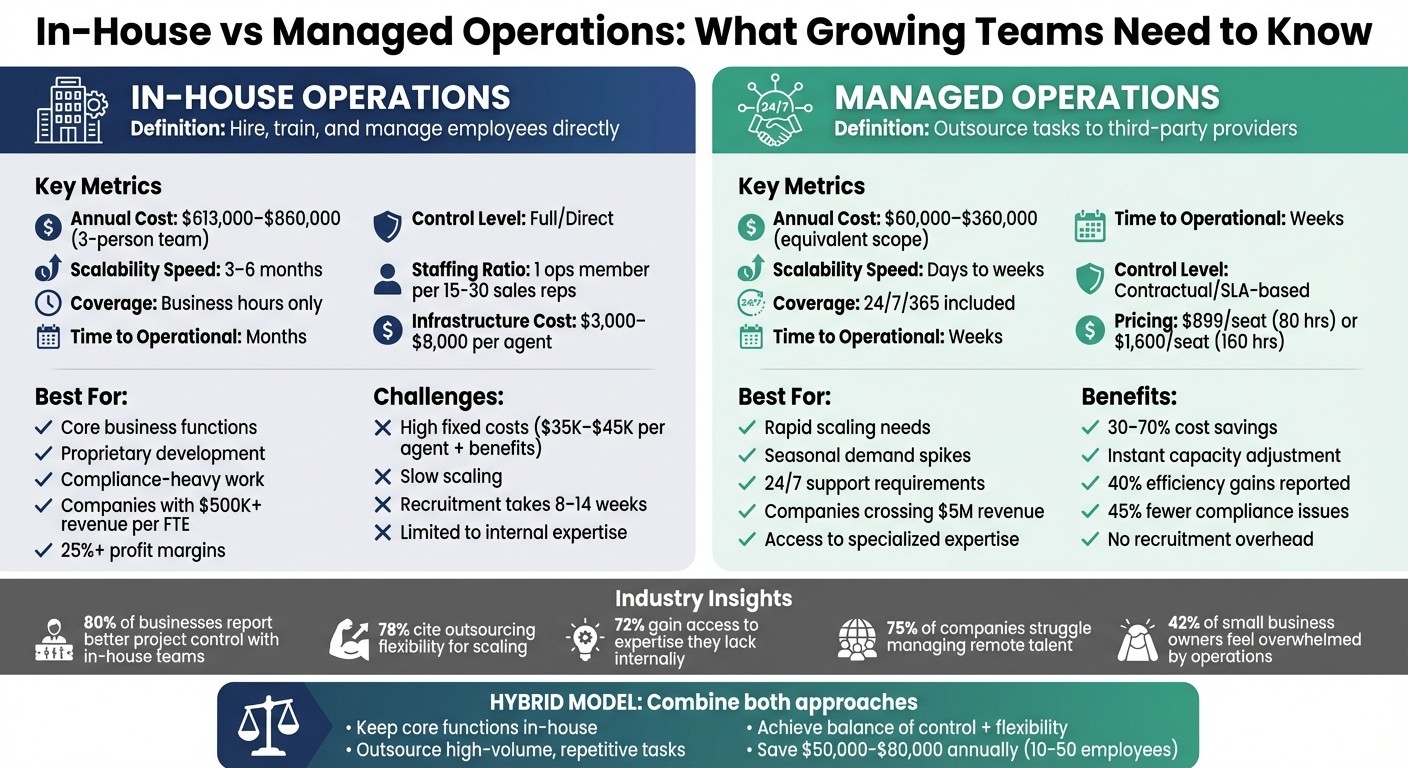
Here’s a clear breakdown of how in-house operations stack up against managed services. The table below highlights the key factors that growing teams need to consider when deciding whether to build internal capabilities or partner with a managed service provider. It also emphasizes the trade-offs mentioned earlier.
For context, Shared Capacity ($899 per seat, 80 hours/month) and Full Capacity Support ($1,600 per seat, 160 hours/month) include an Operations Associate, Team Lead, and Account Manager. Compare this to hiring in-house IT specialists, whose base salaries range from $50,000 to $80,000 each. Once you factor in benefits and overhead, the total cost per specialist often exceeds $150,000 annually.
"In-house IT costs $50,000+ annually per specialist with limited coverage, while managed IT services provide 24/7 support with enterprise expertise and scalability."
– Slobodan Krsmanovic
Ultimately, the decision boils down to what your team values most: direct control or cost efficiency, scalability, and continuous support. If your business is growing rapidly, dealing with seasonal spikes, or lacks the bandwidth to manage internal teams, managed operations can deliver flexibility and lower total costs. Up next, we’ll explore the scenarios where each model works best.
In-house teams shine when your business operations are steady, predictable, and central to maintaining a competitive edge. Companies generating at least $500,000 in annual revenue per full-time employee, alongside a profit margin of 25% or more, can afford to maintain in-house staff without putting undue pressure on cash flow. This model works particularly well for departments that directly contribute to your company’s unique strengths.
Core business functions that set your company apart - like proprietary product development, research and development (R&D), and strategic planning - are excellent candidates for in-house management. These roles often demand a deep understanding of your organization and alignment with its mission. For example, if your business is focused on developing proprietary technology or safeguarding intellectual property, keeping these operations internal ensures you maintain full control over security protocols and sensitive processes.
"Strong internal teams are the drivers. Their value lies in judgment, prioritization, and execution under pressure."
– Cris S. Cubero, Kalungi
In addition to innovation, in-house management is critical for areas requiring rigorous oversight. Roles tied to compliance - whether in legal, finance, or healthcare - are often better managed internally. With 63% of businesses citing concerns about data breaches when outsourcing IT services, keeping sensitive operations in-house can help mitigate risks. Similarly, functions tied to high-touch client interactions or a deep understanding of your brand, such as HR and core marketing, benefit from being handled by teams embedded in your company culture.
Before expanding your in-house team, focus on streamlining your operations and automating repetitive tasks. Hiring as a quick fix for inefficiencies is an expensive mistake. Once your processes are optimized, an in-house team can deliver exceptional value.
Managed operations become particularly valuable when your business starts scaling rapidly - especially once you cross the $5 million revenue mark but can’t justify the cost of a $1 million+ C-suite team yet. This is the "Talent Paradox": you need senior-level expertise in areas like SEO, automation, or paid media, but your budget only allows for junior or mid-level salaries. Managed services solve this by offering access to senior-level expertise on a part-time basis, alongside specialized skills, without requiring full-time hires. This fractional approach bridges the gap between in-house limitations and the support needed for sustainable growth.
Another key benefit? Managed operations free up leadership to focus on strategy. When senior team members are stuck handling day-to-day tasks, it’s easy for burnout to creep in. In fact, about 42% of small business owners report feeling overwhelmed by operational responsibilities.
"The goal of a founder shouldn't be to manage a large team; it should be to manage a large outcome."
– Stefan Chiriacescu, Founder of eCommerce Today
This approach aligns perfectly with the earlier discussions on cost flexibility and scalability. When workforce planning becomes a constant challenge, a managed partner steps in with accountability tied to KPIs and SLAs.
HeyBuddy Solutions offers two tailored plans to meet different operational needs.
The Shared Capacity plan costs $899 per seat and provides 80 hours of operational support per month. This plan is perfect for founders who need help with tasks like inbox management, CRM updates, and handling escalations - without the cost of a full-time hire.
The Full Capacity plan, priced at $1,600 per seat, includes 160 hours per month along with team leads and QA oversight. It’s designed for businesses requiring consistent, high-volume support with reliable execution and daily availability.
Both plans offer predictable pricing, eliminating unexpected costs and recruitment headaches, while setting the stage for seamless scaling.
Managed operations also shine when dealing with fluctuating demand, seasonal spikes, or rapid changes like AI-driven optimizations. Unlike internal teams that may struggle to adapt due to limited R&D capabilities, managed partners bring cross-industry expertise and agile teams - without adding to your headcount. If operational bottlenecks are slowing you down, managed services allow leadership to refocus on driving strategic growth.
A hybrid model brings together the best of in-house and managed operations. By keeping core functions in-house and outsourcing repetitive, high-volume tasks to managed partners, you can create what’s often called a "structured execution layer." This means your team focuses on strategy and solving complex issues, while tasks like inbox management or CRM updates are handled externally. It’s a smart way to stay efficient without overwhelming your internal team.
The trick lies in defining clear boundaries. Core competencies - like proprietary product development, strategic planning, and handling complex escalations - should stay in-house. On the other hand, tasks like payroll, IT maintenance, lead triage, or routine customer service can be outsourced to managed providers.
This approach also addresses a common challenge: coverage. Small and mid-sized teams often struggle to provide 24/7 support or maintain service during holidays. Managed partners step in to fill those gaps, reducing the risk of burnout and ensuring customers always receive timely responses. These partners can also take on back-office tasks and CRM workflows, leaving your internal team free to focus on high-value interactions.
"HeyBuddy helped us bring on associates that fit our team and day-to-day needs. They handled the setup and coordination, and the support was steady and easy to integrate into our existing workflow."
– Kelly Rice, Founder, HealerHive
Before shifting any tasks to a managed provider, it’s essential to document your Standard Operating Procedures (SOPs) and set clear escalation protocols. This step is critical - over 60% of employees report that poor or missing SOPs negatively impact their performance. Start with staff augmentation to handle immediate workloads and stabilize operations. Once SOPs and escalation guidelines are firmly in place, you can transition to a fully managed model. This hybrid approach offers flexibility and scalability, making it easier to adapt as your business grows or market conditions evolve.
Deciding between in-house operations and managed services is a strategic choice that shifts as your business evolves. The best option hinges on your current needs, long-term goals, and key factors like control, speed, and management capacity. For companies with 10 to 50 employees, managed IT services can save between $50,000 and $80,000 annually compared to hiring an in-house team. Additionally, 72% of businesses say outsourcing gives them access to expertise they don’t have internally. This makes regular strategy reviews essential in a fast-changing business landscape.
As teams grow, it’s crucial to revisit operational models annually to ensure they align with both growth and strategic objectives. A setup that worked for a startup might become a hurdle as the company scales, while previously non-core functions could turn into key areas of focus.
A hybrid model - keeping essential functions in-house while outsourcing specialized tasks - can help leadership direct their attention to high-impact priorities.
From cost savings to scalability, every decision should tie back to your growth objectives. The secret lies in setting clear success metrics, defining service-level agreements, and establishing escalation protocols before committing to a specific approach. Whether you choose in-house, managed, or a hybrid model, aligning your operational strategy with your scalability goals is crucial for sustainable growth.
To make a quick decision, start by evaluating your specific needs. Focus on key factors like how much control you want, the speed at which you need to scale, your comfort level with risk, and the management resources you have available. If maintaining direct oversight is important, an in-house or hybrid approach might be the right fit. On the other hand, if your priority is rapid scalability and shifting risks, managed operations could be the better choice.
Use a decision-making framework that aligns with your priorities - whether that’s minimizing operational risks, meeting capacity demands, or balancing management bandwidth. This approach will help ensure your choice supports your growth strategy effectively.
Operational tasks like cybersecurity, data protection, and regulatory compliance are best handled in-house when compliance or security is a concern. Managing these areas internally ensures that sensitive information stays protected and all legal requirements are adhered to. This strategy reduces potential risks and keeps accountability for essential operations firmly within the organization.
To gauge how well a managed provider is performing, focus on the key metrics - KPIs and SLAs - that were agreed upon when your partnership began. Keep an eye on important indicators like project completion rates, error rates, response times, and customer satisfaction scores.
On top of that, operational metrics such as throughput and compliance with agreed terms should also be part of your evaluation. By conducting regular reviews of these metrics, you can ensure the provider is meeting your expectations and effectively contributing to your growth and operational objectives.
Our platform is designed to empower businesses of all sizes to work smarter and achieve their goals with confidence.
May 18, 2026
Best Freelance Sites for Businesses in 2026 and Why Some Teams Outgrow Them
Apr 22, 2026
Best Project Coordination Tools for B2B Teams in 2026
Apr 5, 2026
7 Signs Your Team Needs Operational Support
Mar 5, 2026
Outsourcing Customer Support for Startups